The republic prepares earlier
Roads are measured. Bridges are inspected. Powder is kept dry. Lake craft are counted before panic. Officers learn how to move men before war teaches the lesson in blood.
 Adler TweedStories. Place. Perspective.
Proofs of Empire · Volume I
The First Proof
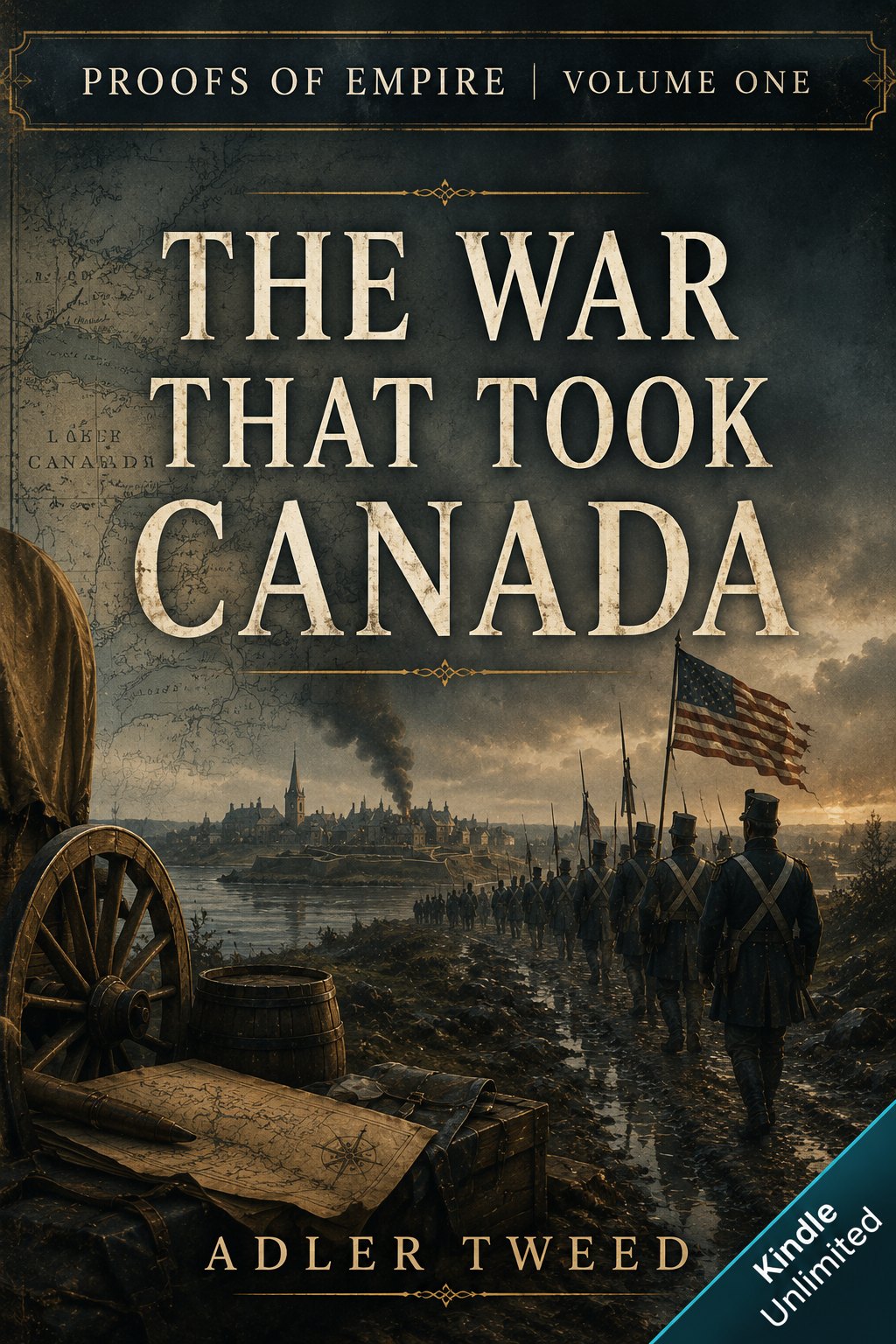
The War of 1812 goes sideways because the young United States changes one boring thing before the shooting starts: it gets better at the unromantic machinery of war.
The pivot, in plain English
In real history, the United States entered the War of 1812 with serious ambitions and serious weaknesses. The republic distrusted standing armies, leaned heavily on militia, improvised logistics, argued about authority, and often discovered the practical meaning of mud, distance, rotten roads, damp powder, bad contractors, and bad timing after it was already too late.
Proofs of Empire changes one thing before 1812: the United States grudgingly invests earlier in professional military capacity. Not a modern army. Not a clean empire machine. Just enough trained regulars, officer instruction, roads, depots, magazines, lake craft, inspections, and quartermaster discipline to make the War of 1812 produce a different result.
That is the hinge. Better preparation does not make America noble. It makes America capable. Capability changes what armies can attempt. What armies can attempt changes what politicians can imagine. What politicians can imagine changes borders, households, churches, claims, maps, schools, memories, and eventually the Civil War itself.
Roads are measured. Bridges are inspected. Powder is kept dry. Lake craft are counted before panic. Officers learn how to move men before war teaches the lesson in blood.
The United States still suffers, blunders, freezes, quarrels, and bleeds. But it can recover faster, move better, and exploit openings that our own history failed to hold.
Upper and Lower Canada are not merely invaded. They are conquered, occupied, renamed, administered, resisted, and converted into the paperwork of American victory.
This is the bait for the Civil War alt-history crowd: the fracture does not disappear. It waits. When the American republic later breaks against itself, the northern wound opens too.
What Book One actually does
The War That Took Canada begins before the fighting, in the offices, roads, magazines, dinner tables, depots, and map rooms where a republic teaches itself to move without admitting how far movement might carry it.
Then the war comes. Detroit, Niagara, the lakes, Kingston, Montreal, Quebec, Halifax, and the treaty rooms become more than campaign stops. They become proof that the dull parts of power are often the most dangerous: ledgers, ferries, parish records, supply roads, claim books, and official phrases that sound harmless until someone has to live under them.
The story follows soldiers, clerks, couriers, sailors, priests, merchants, widows, civilians, Indigenous leaders, commanders, and imperial officials. Nobody gets the clean version of history. Everyone gets the version with mud on the boots and ink on the hands.
The 99-cent confession
Amazon, tragically, has not yet accepted “one lint-covered coin and a promise” as a valid ebook price. So the door price is USD $0.99, or free to read for Kindle Unlimited subscribers.
For that, you get a full-scale alternate-history opening volume: War of 1812, military logistics, conquest, occupation, civil paperwork, British imperial retreat, Indigenous strategy, Halifax as a counterweight, Mexico watching the pattern form, and the first long shadow of a Civil War that will not arrive on the same map.
In plain terms: it is a lot of reading for less than the cost of most vending-machine mistakes.
Who this is for
The change is small enough to be plausible and large enough to wreck the furniture. One institutional pivot becomes five volumes of consequence.
This series is not dodging the Civil War. It is loading the board before the war arrives, with Canada, empire, slavery, expansion, and occupation all rearranged.
The battles matter, but so do the roads, barrels, weather, boats, orders, rank, fear, and paperwork that decide whether armies arrive as plans or as wreckage.
If you have ever stared at a map and thought, “Move that one piece and the whole table shakes,” welcome to the map room.
After the book
The Proofs companion Substack is where the map room stays open after hours: alternate-history causality, reader questions, behind-the-proof notes, possible spin-offs, Mexican and western perspectives, and all the little “what if this domino fell too?” conversations that make historical fiction such a splendidly dangerous toy.
No homework required. No paid push. Just the endless pleasure of asking what history does when one boring administrative decision gets teeth.